
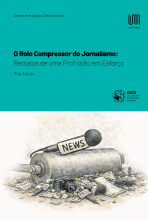
O Rolo Compressor do Jornalismo: Retratos de uma Profissão em Esforço
Keywords:
journalism, emotional labor, precarity, violence, harassment, interviewsSynopsis
Journalism has faced numerous challenges and transformations in recent decades, not only due to technological and digital developments, but also structural constraints within the media industry, which is currently characterised by increasing ownership concentration and a visible collapse of business models. The deterioration of working conditions, precarity and violence against journalists may contribute to emotional strain, affecting their physical and mental health, as well as their well-being and quality of life, but also the quality of journalism itself. Although many of these dimensions stem from structural problems within the media industry, such as declining sales and advertising revenue, contextual factors further exacerbate the situation. The COVID-19 pandemic was one such moment, and several surveys of journalists already pointed to a growing deterioration in the conditions under which journalism was practised (Araújo et al., 2023; Camponez et al., 2020). However, no data were available to examine journalists’ emotional strain and its relationship with the dimensions outlined here. This study aimed to understand Portuguese journalists’ perceptions of emotional strain in their daily practice, its causes and consequences, and the existence of support strategies. To this end, semi-structured interviews were conducted with 50 journalists from various media organisations.
The findings reveal a concerning reality that should prompt societal reflection. Precarious journalists are not free journalists, just as journalists who fear for their safety are not free either.
Downloads
Download data is not yet available.
References
Araújo, R., Lopes, F., Magalhães, O., Sá, A., & Aguiar, A. (2023). Behavior guidance during the Covid-19 pandemic: Health literacy as a weapon against the virus. Health Communication, 38(3), 490–498. https://doi.org/10.1080/10410236.2021.1956070
Bélair-Gagnon, V., Holton, A. E., Deuze, M., & Mellado, C. (2023). Happiness in journalism. Routledge.
Braun, V., & Clarke, V. (2019). Reflecting on reflexive thematic analysis. Qualitative Research in Sport, Exercise and Health, 11(4), 589–597. https://doi.org/10.1080/2159676X.2019.1628806
Camponez, C., Miranda, J., Fidalgo, J., Garcia, J. L., Matos, J. N., Oliveira, M., Martins, P., & Silva, P. A. (2020). Estudo sobre os efeitos do estado de emergência no jornalismo no contexto da pandemia Covid-19. Relatório. Sopcom.
Chen, G. M., Pain, P., Chen, V. Y., Mekelburg, M., Springer, N., & Troger, F. (2020). ‘You really have to have a thick skin’: A cross-cultural perspective on how online harassment influences female journalists. Journalism, 21(7), 877–895. https://doi.org/10.1177/1464884918768500
Crespo, M., Azevedo, J., Sousa, J., Cardoso, G., & Paisana, M. (2017). Jornalistas e condições laborais: Retrato de uma profissão em transformação. OberCom. https://obercom.pt/wp-content/uploads/2017/03/2017_OBERCOM_Jornalistas_Condicoes_Laborais.pdf
Deuze, M. (2004). Journalism studies beyond media: On ideology and identity. Ecquid Novi: African Journalism Studies, 25(2), 275–293. https://doi.org/10.1080/02560054.2004.9653298
Dworznik-Hoak, G. (2022). Emotional labor during disaster coverage: Exploring expectations for emotional display. Journalism Practice, 16(5), 864–882. https://doi.org/10.1080/17512786.2020.1816858
Ekdale, B., Tully, M., Harmsen, S., & Singer, J. B. (2015). Newswork within a culture of job insecurity. Journalism Practice, 9(3), 383–398. https://doi.org/10.1080/17512786.2014.963376
Hoak, G. (2021). Covering COVID: Journalists’ stress and perceived organizational support while reporting on the pandemic. Journalism and Mass Communication Quarterly, 98(3), 854–874. https://doi.org/10.1177/10776990211015105
Holton, A. E., Bélair-Gagnon, V., Bossio, D., & Molyneux, L. (2023). “Not their fault, but their problem”: Organizational responses to the online harassment of journalists. Journalism Practice, 17(4), 859–874. https://doi.org/10.1080/17512786.2021.1946417
Hopper, K. M., & Huxford, J. E. (2015). Gathering emotion: Examining newspaper journalists’ engagement in emotional labor. Journal of Media Practice, 16(1), 25–41. https://doi.org/10.1080/14682753.2015.1015799
Ivask, S., Waschková Císařová, L., & Lon, A. (2023). “When can I get angry?” Journalists’ coping strategies and emotional management in hostile situations. Journalism, 25(10), 2099–2116. https://doi.org/10.1177/14648849231199895
Jukes, S. (2020). Journalism and emotion. SAGE.
Jukes, S., Fowler-Watt, K., & Rees, G. (2022). Reporting the Covid-19 pandemic: Trauma on our own doorstep. Digital Journalism, 10(6), 997–1014. https://doi.org/10.1080/21670811.2021.1965489
Kotišová, J. (2019). The elephant in the newsroom: Current research on journalism and emotion. Sociology Compass, 13(5), Artigo e12677. https://doi.org/10.1111/soc4.12677
Miranda, J., Silveirinha, M. J., Sampaio-Dias, S., Dias, B., Garcez, B., & Noronha, M. (2023). “It comes with the job”: How journalists navigate experiences and perceptions of gendered online harassment. International Journal of Communication, 17, 5128–5148.
Örnebring, H. (2018). Journalists thinking about precarity: Making sense of the “new normal”. # ISOJ Journal, 8(1), 109–127.
Posetti, J., Bell, E., & Brown, P. (2020). Journalism and the pandemic: A global snapshot of impacts. https://www.icfj.org/sites/default/files/2020-10/Journalism%20and%20the%20Pandemic%20Project%20Report%201%202020_FINAL.pdf
Rick, J. (2023). Journalists considering an exit. In V. Bélair-Gagnon, A. E. Holton, M. Deuze, & C. Mellado (Eds.), Happiness in journalism (pp. 11–18). Routledge.
Rick, J., & Hanitzsch, T. (2024). Journalistic work during a pandemic: Changing contexts and subjective perceptions. Journalism Practice, 18(1), 99–118. https://doi.org/10.1080/17512786.2023.2250760
Sampaio-Dias, S., Silveirinha, M. J., Garcez, B., Subtil, F., Miranda, J., & Cerqueira, C. (2023). “Journalists are prepared for critical situations … but we are not prepared for this”: Empirical and structural dimensions of gendered online harassment. Journalism Practice, 18(2), 301–318. https://doi.org/10.1080/17512786.2023.2250755
Šimunjak, M. (2023). Teaching emotional intelligence for enhancing resilience in journalism. Journalism and Mass Communication Educator, 78(2), 127–141. https://doi.org/10.1177/10776958231165103
Šimunjak, M., & Menke, M. (2023). Workplace well-being and support systems in journalism: Comparative analysis of Germany and the United Kingdom. Journalism, 24(11), 2474–2492. https://doi.org/10.1177/14648849221115205
Steiner, L., & Chadha, K. (2022). Introduction. Global precarity’s uneven impacts on journalism. In K. Chadha & L. Steiner (Eds.), Newswork and precarity (pp. 1–11). Routledge.
Storm, H. (2024). Mental health and wellbeing for journalists. A practical guide. Routledge.
Thomson, T. J. (2021). Mapping the emotional labor and work of visual journalism. Journalism, 22(4), 956–973. https://doi.org/10.1177/1464884918799227
Varela, R., Santa, R. della, Rolo, D., Areosa, J., Antunes, J. A., Silveira, H., Santiago, B., & Souza, R. (2023). Inquérito nacional às condições de vida e de trabalho dos jornalistas em Portugal. https://jornalistas.eu/wp-content/uploads/2023/11/Inquerito-Nacional-as-Condicoes-de-Vida-e-de-Trabalho-dos-Jornalistas-em-Portugal-03-11-2023-c.pdf
Downloads
Published
June 23, 2026
Series
Copyright (c) 2026 Rita Araújo